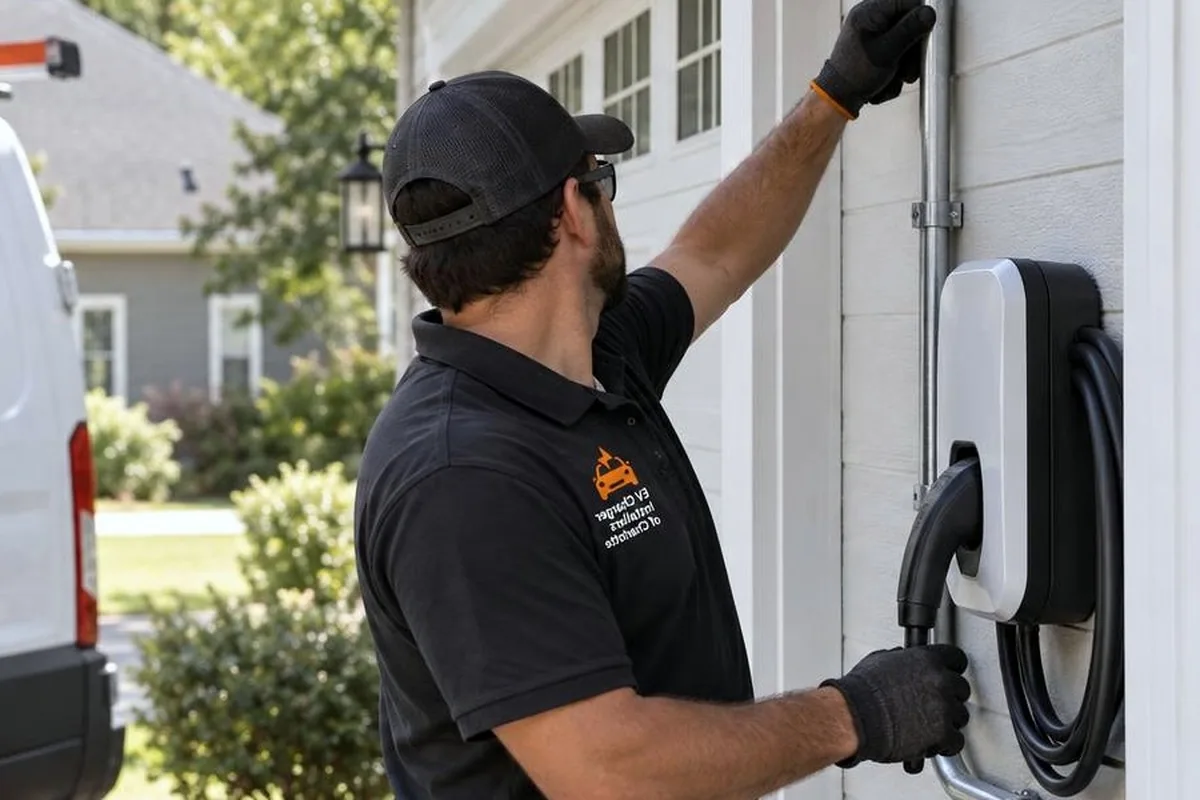
Electrician in gloves fitting a wall-mounted EV charger beside a white garage door

EV Charger Permits in Cary: What the Town of Cary Requires Before Your Charger Goes Live

The Town of Cary EV Charger Permit, Fee and Inspections, Explained

EV Charger Installers of Cary put this page together because Cary is one of the few Triangle towns with its own written guide for the EV charger permit in Cary, NC. The Town of Cary EV charger permit covers your new circuit, sets the Cary permit fee and lines up each EV charger inspection. Below you will find why it is required, what it costs, which inspections follow and how it ties into the Duke credit.

Why homeowners choose us:

  • NC-licensed electrical work from breaker to charger
  • Town of Cary permit filed online, inspected to final
  • Apex Electric or Duke? answered at the estimate
  • Free written estimates with the permit fee shown

We are licensed North Carolina electricians, and Cary permits have been part of our charger work for many years. We apply online, pay the fee on your behalf and meet the inspectors, so the permit never becomes your errand. Every free written estimate we give shows the permit as its own line, and the approved permit goes straight into your Duke credit file.

Get a FREE EV Charger Installation Quote

Why the Town of Cary Requires a Permit for a Home EV Charger

Cary’s residential EV charger guide points to state law, NCGS 160A-417, as the reason a permit is required. A charger adds a large, steady load to your home’s wiring, and the permit is how the town confirms the installation protects the people living there.

The town’s Inspections and Permits staff review and issue electrical, mechanical, plumbing and building permits under the State of North Carolina building codes. For a home charger, the Cary electrical permit is the one that matters most. It covers the new breaker, the wire run, the receptacle or hardwired connection and any panel work done for the charger.

NEC Article 625 and Listed Equipment

Cary’s guide sets two technical rules for charger equipment. Electrical work must comply with NEC Article 625, the part of the electrical code written for EV charging equipment. Every charger and component also has to be listed and labeled by an approved testing agency, which rules out unlisted bargain units. Under Article 625 a charger counts as a continuous load, which is why the breaker carries a 25 percent margin over the charger, and a 48-amp unit gets a 60-amp breaker.

Cary EV Charger Permit Fees and Turnaround

The Town of Cary publishes its fees and timing in the same guide. Here is what a typical home charger permit involves:

ItemTown of Cary figure
Minimum permit fee$100 per trade
Typical home install, electrical and mechanical$200 total
Processing timeAbout two business days for a complete application
Where to applyOnline, through the town’s permitting portal
Who can applyProperty owners and their contractors
QuestionsCall 311 or 919-469-4046

Each trade on a job carries its own minimum fee, which is why the guide’s example with both electrical and mechanical work totals $200. A charger circuit on its own falls under the electrical trade.

A complete application moves fastest, so we submit the circuit size, the charger model and the panel details together. The permit fee passes through to you on its own invoice line. It is never folded into labor, which keeps your Duke credit paperwork clean.

Timing matters for planning. With about two business days for processing, a Cary permit rarely sets the install date. Most delays come from incomplete applications, such as a missing charger model or an unclear panel rating, and those are the details we gather at your estimate.

The Inspections Behind a Cary EV Charger Permit

Cary’s Inspections and Permits staff review and inspect electrical, mechanical, plumbing and building work across town. For a charger, the guide lists these visits:

Each EV Charger Inspection, in Order

  • Groundwork inspection checks any buried conduit before a trench to a detached garage or a post is closed.
  • Rough-in inspection is added when wiring or components would be hidden by the time of the final.
  • Final electrical inspection checks the finished circuit, breaker, charger and labeling.
  • Mechanical inspection applies when the installation includes ventilation equipment.

We book every visit and meet the inspector, so you do not have to wait at home. Most installs in attached garages keep the wiring visible, which keeps the inspection list short.

At the final, the inspector looks at the breaker size against the charger’s rating, the wire gauge, the grounding and the labeling in your panel. A charger that passes is one you can leave running every night with confidence, and the approved inspection closes out the permit.

Apex Electric or Duke Energy: Which Utility Serves Your Cary Address

Cary homes do not all buy power from the same company. Town of Apex Electric has run its own town-owned electric system since 1917, serving Apex, parts of Cary and some rural areas. Most of the rest of Cary is served by Duke Energy Progress, and in the Triangle two neighbors can sit on different utilities.

The name at the top of your power bill answers the utility question. The permit process is the same either way, because it belongs to the Town of Cary, not to your utility. The credit is the part that changes, since only Duke customers can claim the Duke Charger Prep Credit. We read the bill at the estimate, so your quote matches the utility that actually serves you. Homes that just closed and have no bill yet can ask the Town of Apex whether the address is on town power.

How a Cary EV Charger Permit Keeps the Duke Credit in Reach

Duke’s Charger Prep Credit, worth up to $1,133, needs the approved permit attached to each application. Without one, the claim cannot go in, and unpermitted work can also complicate a future insurance claim.

The credit pays for the make-ready work, meaning the wiring, outlet, breaker and any panel upgrade made for the charger. Excluded every time are the charger, the labor to mount it and the permit fee, so the Town of Cary fee stays your cost even when the credit comes through.

Duke also wants an itemized, paid invoice that breaks out labor, materials and the permit cost, plus your EV registration at the Duke address. You apply within 120 days of the later of the invoice or the registration. Our Cary invoices follow that layout, and the approved permit goes into your file on the day it is issued.

A few more Duke rules apply in Cary. You must own the home, so renters cannot claim, and the limit is one rebate for each EV registered there. The EV can be owned or leased.

If an install is next on your list, start with a Tesla charger installation or check whether your home needs an EV charger panel upgrade first. One Cary permit covers both jobs.

EV Charger Permits FAQs: Cary, NC

Do I need a permit for an EV charger in Cary?

The Town of Cary requires a permit for home EV charging equipment, citing state law NCGS 160A-417. Property owners or their contractors apply online.

How much does a Cary EV charger permit cost?

The minimum fee is $100 per trade. The town's guide puts a typical residential install with electrical and mechanical work at $200.

How long does the permit take?

Complete applications are usually processed in about two business days. Incomplete ones take longer, so we submit everything at once.

What inspections will my charger need?

Electrical work gets a groundwork inspection and a final inspection, plus a rough-in when wiring would be hidden. Ventilation equipment adds a mechanical inspection.

Does the permit change if I am on Apex Electric?

The permit stays the same, because it comes from the Town of Cary. Only the credit changes, since Apex Electric customers cannot claim the Duke credit.

Can I pull the permit myself?

Property owners can apply, but the Duke credit still requires work by an electrician with a state license. We handle the permit as part of every install.

EV Charger Installers of Cary serves Cary and Wake County.

Get a Free EV Charger Installation Quote in Cary, NC

(919) 335-7926 Get a Free Quote